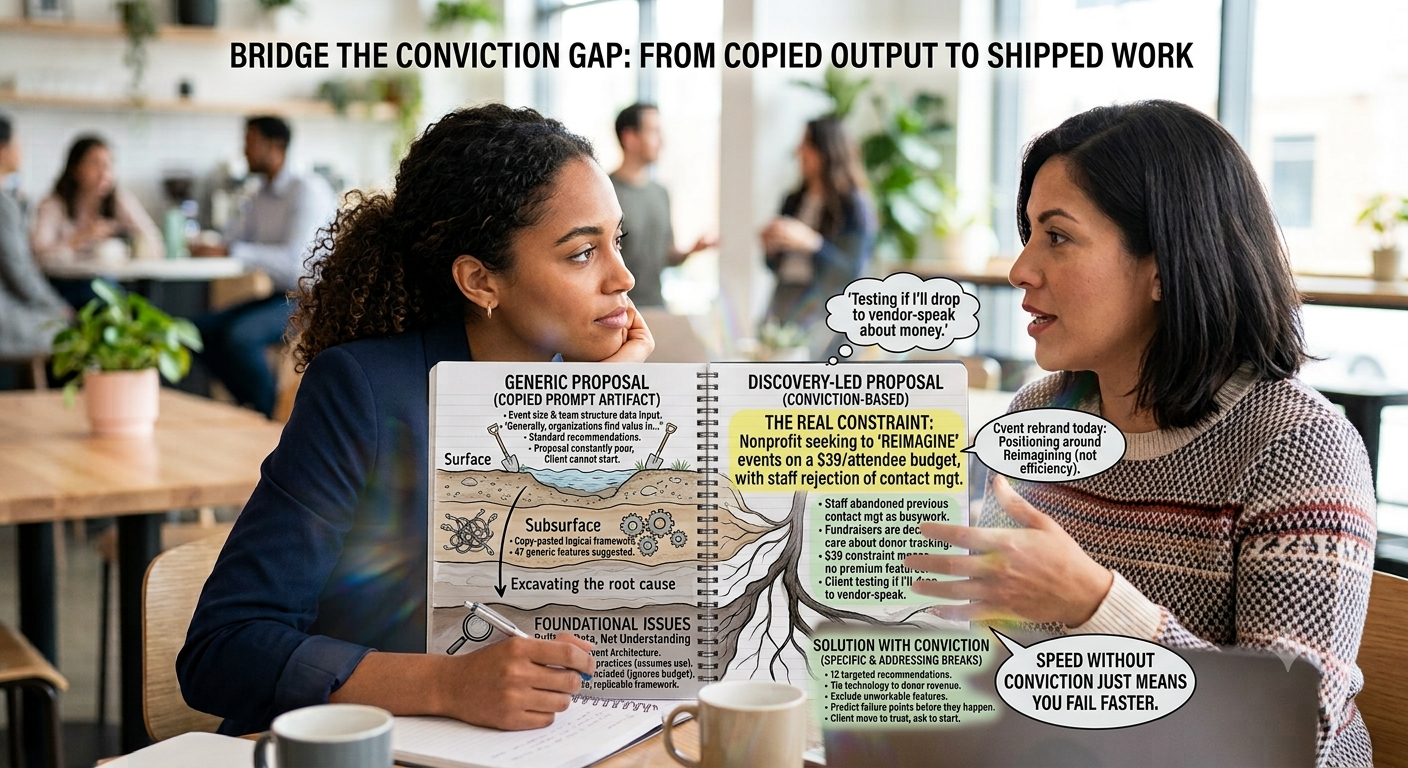


He ran the prompt and showed me the output. An architecture brief. A proposal framework. All the pieces were there — the discovery questions, the Cvent configuration, the ROI justification. It looked like what I’d built.
It wasn’t.
I could tell immediately. Not because something was wrong technically. Because nothing was brave about it. Everything was hedged. Every recommendation included a qualifier. “This is recommended, though depending on your setup…” “Generally, organizations find value in…” “Consider implementing…”
Safe. Generic. Designed not to be wrong instead of designed to be right.
He’d copied the prompt. Copied the structure. Gotten back something that looked like architecture. What he hadn’t copied was the conviction that had to live underneath the words. And the client saw it immediately. They didn’t say “this is generic” directly. They said, “How does this fit our situation?” Which is the polite version of: “This could apply to anyone.”
That’s when I understood what was actually different between what worked and what didn’t.
The Conviction Gap
Conviction isn’t confidence. Confidence is what you feel when the data supports your recommendation. Conviction is what you feel when you’ve understood something specific about this client — their constraint, their fear, their real problem underneath the stated one — and you know exactly why a specific approach will work for them, not just generally.
Confidence says: “Based on best practices, you should do this.”
Conviction says: “I’ve talked to your team. I know your budget per attendee is $39 for the entire event tech stack. I know you’ve tried contact management before and your staff didn’t use it. I know your fundraisers care about donor tracking more than attendee management. So here’s exactly what will work for you, and here’s where it will break, and here’s how we fix it.”
One is replicable. One isn’t.
When my colleague ran my prompt, he got the first version. He got the framework that made logical sense. What he didn’t get was the context underneath — the six months of conversations, the specific constraints I’d learned through discovery, the failure points I’d predicted, the choices I’d made to exclude things that wouldn’t fit.
He had the artifact. He didn’t have the understanding that made the artifact work.
What Discovery Actually Does
Most people think discovery is about gathering information. “Let’s call the client, ask some questions, understand their setup.” That’s research. Discovery is different.
Discovery is listening for the moment underneath the moment.
I was on a call. Client came ready to talk pricing and architecture review. Within minutes they jumped straight to budget. Most people hear “budget question” and start justifying cost. I heard something else: testing. They were checking if I’d drop to vendor-speak the second money came up.
So I didn’t answer the price question. I leaned into what was underneath it.
“What’s the real constraint here?” Not challenging. Just honest.
They paused. Then they said something different: “We’re trying to reimagine what events mean for us.”
That word — reimagine — that’s the actual thing. Not budget. Reimagining.
And I’d seen something that morning. Cvent had rebranded. Same day. And the rebrand was all about platforms enabling reimagining. Not efficiency. Not reporting. Reimagining.
So I said it back to them: “I saw Cvent rebranded this morning. They’re positioning exactly around that.”
The room shifted. Suddenly they weren’t asking about price. They were asking: “What are other clients doing? How good is contact management for this? Why this approach? Should we phase this?”
Different questions. Completely different.
That’s discovery. That’s listening for what the client is actually trying to do underneath what they’re saying they want.
Then you build the architecture around that. Not the standard template. Not the generic recommendations. The specific thing they need because of the specific thing they’re trying to do.
What My Colleague Missed
He ran the prompt on the same client data. Event size. Team structure. Current setup. And he got a recommendation: “For a nonprofit your size, here’s the standard Cvent architecture.”
Standard. Built on inputs. Not on understanding.
He didn’t hear that the client was testing him. He didn’t catch the word “reimagine.” He didn’t notice the Cvent rebrand that day. So he generated generic recommendations — contact management best practices, standard reporting, premium features that look good but don’t fit.
His client couldn’t start on the proposal. The output was constantly poor. They didn’t know where to begin.
Because it was built on the template, not the client.
And here’s what kills it: an agent would do exactly the same thing. Faster.
Why Speed Breaks Everything
An agent sees the same data and generates architecture in minutes. The client’s Cvent setup, their event volume, their team structure — all fed into a system that says: “For a nonprofit running 12 events a year with a 15-person ops team, here’s what works.” Reasonable. Fast. Probably half-right and half-wrong because the agent doesn’t know which half is which.
The agent doesn’t know that the ops team abandoned contact management three years ago because their director thought it was busywork. The agent doesn’t know that the $39/attendee constraint means you can’t add premium Cvent features even if they’d help. The agent doesn’t know that the fundraisers are the actual decision-makers and they think everything is overhead until you tie it to donor revenue.
An agent can’t skip to conviction because conviction requires having been in the room when the client said the thing they didn’t mean to say. It requires predicting the failure point before it happens.
Speed doesn’t do that. Understanding does.
So when my colleague ran the prompt, he got fast output. What he got was confidence masquerading as conviction. It looked right. It sounded professional. It was built on nothing specific.
The Discipline of Exclusion
Here’s what happened after that call. I didn’t generate a standard architecture. I started with: what does “reimagining” actually require?
Not contact management best practices. Not premium reporting. Not every integration Cvent offers.
Just: what does a nonprofit need if they’re genuinely trying to reimagine how events work? And critically: what can they actually implement given their constraint? (The full event tech stack costs $39 per attendee. That’s the entire margin.)
So I excluded things. A lot of things.
My colleague’s output had 47 recommendations. Mine had 12. Not because I’m lazy. Because I know which 12 they’ll actually use. I know the other 35 would sit in a document and create decision fatigue. I know the $39 constraint means you can’t add premium features hoping they’ll upgrade.
That’s the discipline. That’s what conviction actually is — the willingness to say no to industry best practices because you know they won’t land for this specific client.
An agent can’t do that. It generates. It includes everything. It assumes the client will figure out what fits.
The client can’t. They’re buried.
And when I presented the architecture back them, they knew immediately. Not because I explained it well. Because every recommendation in there had a reason that connected to what they’d said in the call. Every choice was built around reimagining. Every constraint was baked in, not applied after.
That’s conviction. That’s why they moved from “is this worth the price?” to “when can we start?”
The Real Cost of Poor Output
When he showed me the output, I asked: “What did the client say?”
“They haven’t been able to start on the proposal yet. The output is constantly poor. They don’t know where to begin.”
That’s the actual cost. Not “generic” or “off-brand.” Can’t use it. Can’t move forward.
An agent would produce the same result faster. And it would fail the same way — because it would generate recommendations without understanding which ones the client would actually implement, without predicting the breaks, without baking in the constraints.
Speed without conviction just means you fail faster.
The Agent Can’t Have It
You’ll be told agents can do this. “It’ll listen to the client, understand the constraint, build custom architecture.” Fast. Cheap. At scale.
It won’t. Not the way that matters.
An agent listens to data. You listen to what’s underneath the data. An agent generates recommendations. You generate only the ones that will land. An agent assumes constraints are something to work around. You build inside them from the start.
The agent’s job is speed. Your job is understanding. And speed doesn’t understand.
An agent would have heard “budget question” and generated cost justification. You heard testing and shifted the whole frame. An agent would have missed the Cvent rebrand that day. You noticed it and connected it to what they actually needed. An agent would have generated 47 recommendations. You gave 12 because you know the other 35 would destroy the project.
That’s conviction. That’s the thing agents can’t manufacture.
My colleague had the prompt. He had the structure. He had AI running in the background. What he didn’t have was the listening. And listening is the only thing that turns confident output into work that actually ships.
Conviction is what gets a client from “this looks right” to “we’re doing this.”
The Door
There’s a moment in every call when a client shifts from testing you to trusting you. It’s not when you explain your process. It’s when you say “and this is where it will break” and they realize you’ve already thought through the thing they were afraid of. That’s conviction. That’s the moment they stop asking if you’re selling them something and start asking if you can deliver it.
An agent will never have that moment. It can’t predict the specific break because it doesn’t know the specific situation. It just knows what usually works.
You do. And if you’re building solutions with AI, that’s the only part that matters.



Leave a Reply