

My son is 2. I made one rule when he was born — I don’t pick him up when he falls. The harder version of that rule is staying out of the way when nothing’s wrong.
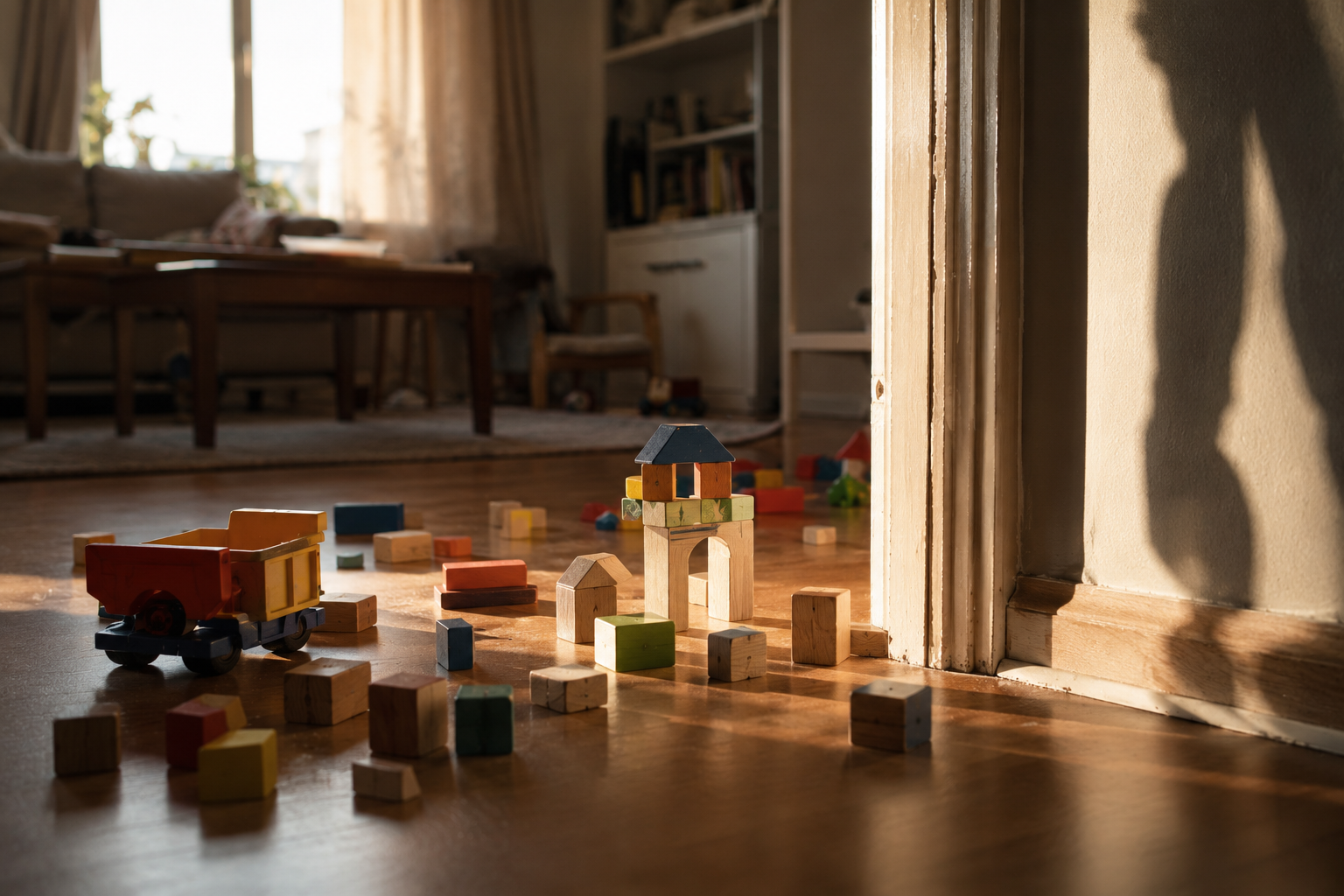
Yug is 2 years and 20 days old. He was deep in something — blocks, or a truck, or whatever logic a 2-year-old applies to objects at 7am — and I walked over and sat next to him.
He stopped what he was doing and looked at me.
Then he wanted to play with me.
That was it. Whatever he was building in his head, gone. The moment I entered the frame, I became the most interesting thing in it. And I’d done it again — interrupted something that didn’t need me in it.
I made one rule when he was born: I don’t pick him up when he falls.
Not when he trips on the mat. Not when he misjudges a step and goes down hard on his hands. Not when gravity wins, which at his age is often. I watch. I stay close. I don’t move toward him unless it’s the kind of fall that needs me.
He gets up. Every time, so far, he gets up.
What I didn’t anticipate was that the harder version of the same rule isn’t about falling. It’s about sitting still while he’s fine. While he’s inside something that’s working. While nothing is wrong and he doesn’t need me and I’m just — there. Watching. Finding reasons to participate.
The instinct to interrupt isn’t concern. He’s not in danger. It’s something else. The pull to be useful, to be included, to register on him somehow.
He’s 2. He doesn’t know he’s teaching me anything.
The rule exists because I had the theory before I had the evidence. I decided early that a child who learns the floor is safe — that falling doesn’t require rescue — builds something I can’t hand him. A private understanding of what he can do and what the world will do back. I’d already felt a version of it once, eleven months into his life, on a mountain neither of us will remember the same way.
Twenty days past two years, the evidence is coming in.
He climbs things that have no business on a toddler’s itinerary. He falls, looks at whatever got him, and tries again. Not always differently. Sometimes exactly the same way, which is either stubbornness or stupidity and at his age the line is invisible. What he doesn’t do is look at me first.
He already knows I’m not coming.
The self-play interruption is harder to justify. There’s no safety logic. It’s just me, miscalibrating my own usefulness.
Every time I walk in and sit down, I’m teaching him something I don’t mean to: that the most interesting thing in any room is me. That whatever he was doing alone wasn’t quite enough. That company improves things.
I want him to find the room enough. The blocks, the truck, the 7am logic that makes sense only to him. I want him to be able to disappear into things without needing an audience.
So now I stop at the doorway. I watch from there. I leave before he sees me.
The fear doesn’t go away. Two years in, I still feel it every time he goes for something difficult.
The difference is I’ve stopped letting it speak.
Because if I tell him to be careful, I’m not protecting him. I’m handing him my fear and asking him to carry it. He’ll start looking at the slope and feeling something that isn’t his — something he inherited from me before he had any evidence it was warranted.
I want him to try the thing. Fail at it. Try it again. And again. Until he gets it or decides it isn’t worth it. That’s his call to make, not mine.
My job is to let him fly without clipping his wings with my own limits.
He’s 2 years and 20 days old. He doesn’t know what he can’t do yet.
I’m not going to be the one who tells him.

Leave a Reply